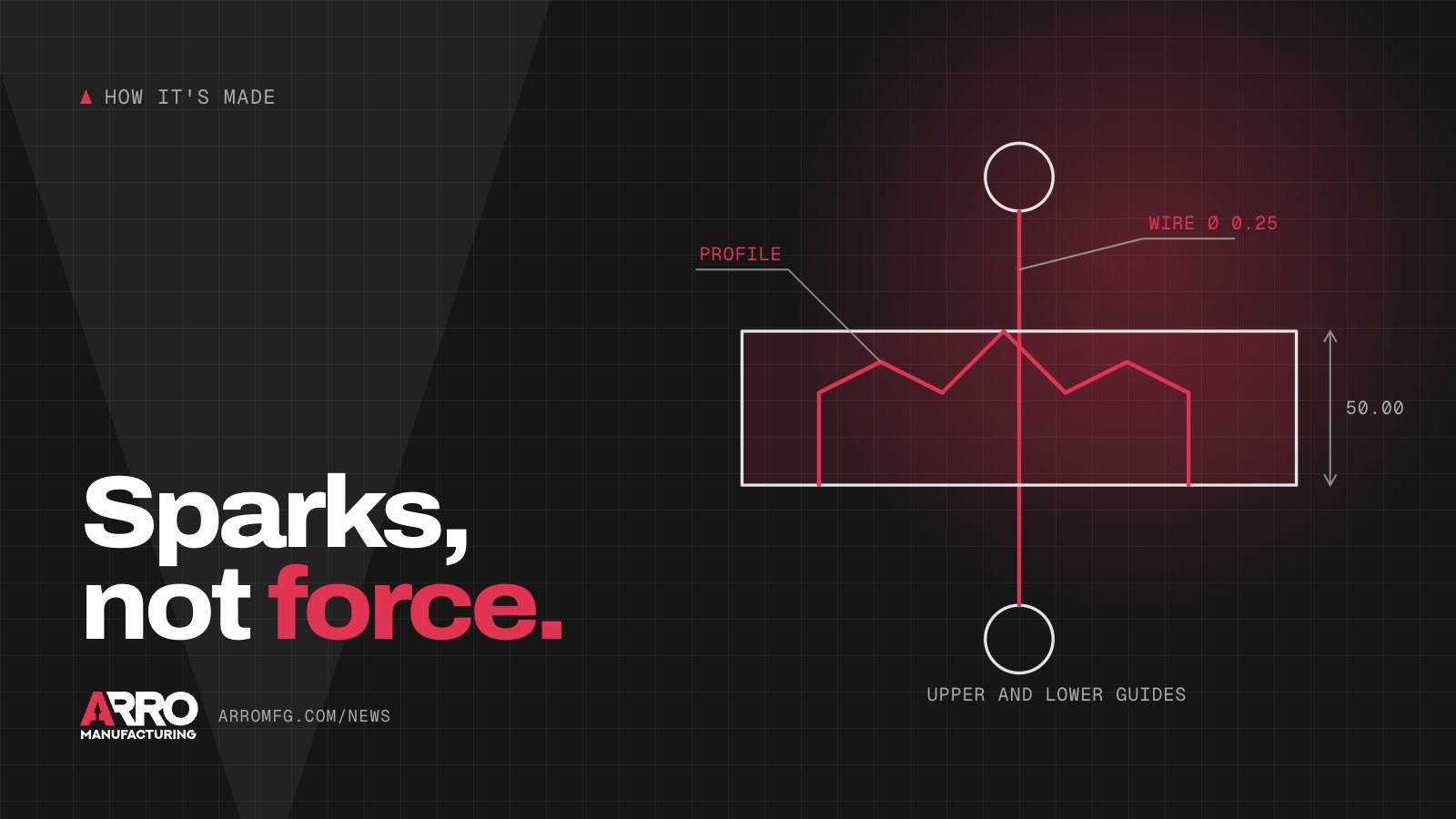
Wire EDM cuts metal without ever touching it. A thin, electrically charged wire follows a programmed path through the workpiece, and a steady stream of tiny sparks between the wire and the steel erodes a narrow slot. A spark does not care how hard the steel is. That is why wire EDM became a standard machine in die shops and toolrooms.
What electrical discharge machining is
Electrical discharge machining, or EDM, removes metal with controlled sparks. The electrode and the workpiece are held a tiny distance apart in a fluid that does not conduct electricity well, called the dielectric. The machine builds voltage across the gap until the fluid breaks down and a spark jumps. Each spark melts and vaporizes a microscopic crater of metal, and the fluid cools the spot and carries the debris away.
Repeat that fast enough, in a controlled pattern, and the craters add up to a cut. Nothing touches, so there is no cutting force. The process grew out of Soviet research in the 1940s, and wire EDM followed in the 1960s, developed largely for making dies from hardened steel.
Sinker EDM uses a shaped electrode that burns its own form into the work. Wire EDM uses a moving wire instead and cuts profiles all the way through a part, like a very precise bandsaw that never touches the metal.
How a wire machine cuts
The wire comes off a spool, passes through the cut and goes to a scrap bin. It is used once. Brass is the standard wire, with zinc coated and other specialty wires for more speed. Diameters commonly run from about 0.004 to 0.012 inch, and 0.010 inch brass is the everyday choice in most shops. Thinner wire reaches finer detail but carries less current, so it cuts more slowly.
The rest of the setup:
- Guides. An upper and a lower guide, usually diamond, hold the wire straight above and below the work. On most machines the upper guide can also move on its own axes to cut a taper.
- Tension. The wire is held under steady tension between the guides. Too little and it wanders. Too much and it breaks.
- Dielectric. The cut happens in deionized water, with clean water flushed into the gap around the wire. Filters and deionizing resin keep the water's conductivity low and steady so the sparks stay predictable.
Since the wire has to pass through the part, an internal shape like a die opening needs a start hole. It is usually drilled before heat treat, while the steel is still soft. Most modern machines thread the wire automatically, so a plate with several openings can run unattended.
Skim passes for finish and accuracy
A precision wire cut is rarely a single pass. The rough cut runs at high power to get the slug out fast. It leaves a rougher surface with a thin re-melted layer, and the steel may move slightly as internal stresses release. Skim passes then follow the same path, offset a little closer to final size each time, with lower current and higher wire tension. The result is better size, straighter walls and a finer finish. A clearance cut may need only the rough pass. A precision punch or die section gets several skims.
Why toolrooms rely on it
For die work, wire EDM does things milling and grinding cannot.
It cuts after heat treat. Tool steel can distort when it is hardened, so a section machined to size first may not stay there. With wire EDM, the toolmaker roughs the block, has it hardened, then cuts the finished profile in hard steel. Hardened tool steel actually tends to cut well, since it is clean and uniform.
It makes sharp inside corners. A milling cutter leaves an inside radius at least as big as the cutter. A wire leaves a much smaller one, and outside corners can be dead sharp.
There is no cutting force. Thin punches, narrow slots and delicate features do not get pushed or deflected while they are cut.
Punch and die can share one path. The same profile can cut both the punch and the die opening, with different offsets to set the clearance between them. Angular relief below the die land can be cut in the same setup by tilting the wire.
Wire EDM puts the final shape into steel after it is already hard, without pushing on it.
Where wire EDM falls short
It only works on materials that conduct electricity. Tool steel, carbide, aluminum, copper and titanium are fine. Plastics, glass and most ceramics are not.
It is slow at removing a lot of material, since the wire only erodes a narrow slot. Squaring a block or clearing a big pocket is a job for a mill. It only cuts through the part, so blind pockets need milling or sinker EDM. Thick parts and extra skims add machine time, and the slug cut from an opening has to be supported so it does not shift and pinch the wire.
At Arro, Wire EDM is part of how we build dies, punches and fixtures in house, and we also run it for customers who need hardened or detailed parts cut to a print. We program in Mastercam and Esprit, handle heat treating as part of the job, and back it up with precision machining. If you have a part that needs it, request a quote or call 716-217-6800.
Sources
- en.wikipedia.org/wiki/Electrical_discharge_machining
- mmsonline.com/articles/buying-a-wire-edm-wire-considerations
- mmsonline.com/articles/buying-a-wire-edm-speed-accuracy-and-finish
- iqsdirectory.com/articles/edm/wire-edm.html
- absolutemachine.com/wp-content/uploads/2014/08/This-is-in-when-micro-wire-EDMing-MICROmanufacturing.pdf